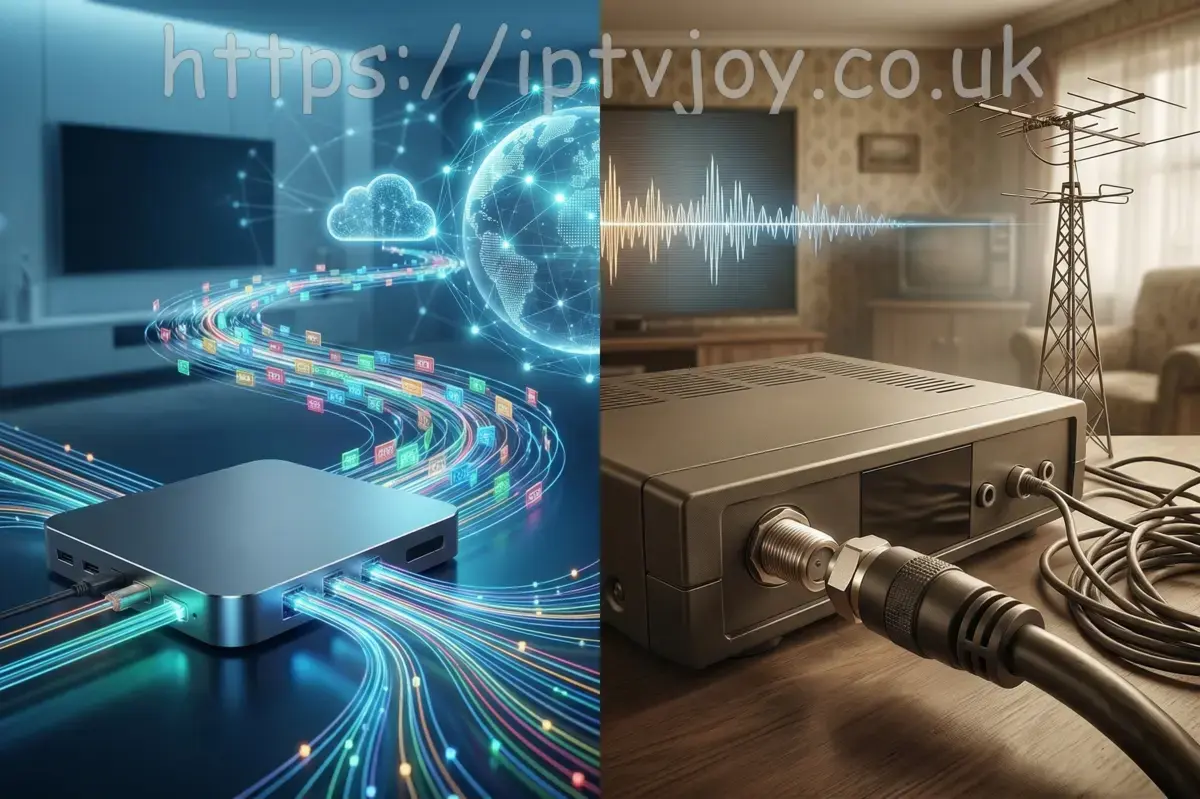
IPTV vs Cable TV — Which Is Better in 2026?
Cable and satellite TV have been the default for decades. Sky, Virgin Media, BT, Freeview, YouView — they are household names. But with prices climbing past £100 per month for full packages and content still locked behind multiple subscriptions, more people are asking whether IPTV is the better option.
This is an honest, side-by-side comparison. We will show you where cable still wins, where IPTV dominates, and help you decide which is right for your household.
The Quick Answer
For most households, IPTV is the better choice. It costs a fraction of what cable charges, offers ten times the content, works on any device you already own, and does not lock you into a long-term contract.
Cable still wins on reliability and regulation. If you have unreliable broadband, prefer dealing with an Ofcom-regulated provider, or want the simplicity of a bundled broadband-and-TV package, cable is the safer choice.
The rest of this page breaks down exactly why, factor by factor, so you can decide based on what actually matters to your household — not just the headline numbers.
IPTV vs Cable — Side-by-Side Comparison
Twelve factors that matter most when choosing between IPTV and traditional cable or satellite TV. We have compared IPTVJoy against the major providers — Sky, Virgin Media, BT, and Freeview.
Prices based on standard packages from Sky, Virgin Media, and BT as of early 2026. IPTV pricing reflects IPTVJoy plans starting from £6.67/month. See full pricing breakdown.
Where Cable and Satellite Still Win
We are not going to pretend IPTV is perfect for everyone. Traditional TV providers have real advantages that matter to certain households. Here is where cable and satellite genuinely come out ahead.
Regulated and Fully Licensed
Cable and satellite providers like Sky, Virgin Media, and BT operate under Ofcom regulation. Every channel is fully licensed, and the service comes with consumer protections that are backed by law. For people who value that regulatory safety net, cable is the safer mainstream choice.
Consistent Quality Regardless of Internet
Satellite TV does not depend on your broadband connection at all, and cable services use a dedicated coaxial line. That means no buffering during peak hours, no quality drops when someone else in the house is downloading a large file, and no dependency on your router or ISP.
Professional Installation
A trained engineer comes to your home, installs the dish or connects the box, runs the cables, and makes sure everything works before they leave. You do not have to configure anything yourself or troubleshoot connection issues. It simply works from day one.
Bundled Broadband Deals
Sky, Virgin Media, and BT all offer broadband, TV, and phone bundles that can work out cheaper than buying each service separately. If you need a new broadband contract anyway, bundling can make financial sense — especially with introductory offers.
Mainstream Brand Trust
Sky has been a household name for over 30 years. Virgin Media and BT are equally established. There is a comfort factor in dealing with a brand you know, one that has high-street shops, a known complaints process, and a reputation to protect.
For a detailed look at how IPTV compares specifically to Sky, read our IPTV vs Sky deep-dive on the blog.

Where IPTV Dominates
When it comes to price, content volume, flexibility, and freedom from contracts, IPTV is not just slightly better than cable — it is a fundamentally different proposition.
10x Cheaper
Plans start from just £6.67 per month — that is £80 per year. A comparable Sky package with sports and cinema costs £960+ per year. Over a typical 18-month contract, the saving is well over £1,000. That is not a marginal difference; it is an entirely different price category.
10x More Content
45,000+ live channels versus 100–300 on cable. 80,000+ on-demand titles versus whatever your provider decides to offer. International channels from 200+ countries versus a handful of add-on packs. The content library is not even comparable.
Watch on Any Device
Amazon Firestick, Smart TV, Android phone, iPhone, iPad, laptop, PC, MAG box — IPTV works on all of them. You are not locked into a proprietary set-top box that only works in one room. Watch in the living room, the bedroom, or on the train to work.
No Contracts, No Commitments
Pay monthly, quarterly, or annually — whatever suits you. Cancel whenever you want with no exit fees, no early termination charges, and no phone calls to a retention team trying to keep you. Your subscription, your terms.
International Content Included
Channels from across Europe, the Middle East, Asia, Africa, and the Americas are all included in every plan. Cable providers charge extra for international channel packs and still only offer a fraction of what IPTV provides as standard.
PPV Events Included
Boxing and UFC pay-per-view events that cost £20–£25 each on Sky or BT are included in your IPTV subscription at no extra charge. Over a year with 10–15 major PPV events, that is another £200–£375 saved on top of your subscription savings.
Who Should Stick with Cable
- You want the safest mainstream option. Regulated by Ofcom, backed by established brands, and supported by high-street shops. If consumer protection and brand trust matter more than price, cable is right for you.
- You need a bundled broadband deal. If you are moving house or your broadband contract is ending, a Sky or Virgin Media bundle that includes TV and broadband together can be more convenient and sometimes cheaper than buying separately.
- You have unreliable broadband. If your internet drops out regularly or you are in a rural area with slow speeds, satellite TV will give you a more consistent experience than any internet-dependent service.
- You do not want any technical setup. Cable and satellite are true plug-and-play. An engineer installs everything, hands you a remote, and you are done. No apps to download, no settings to configure.
Who Should Switch to IPTV
- You are frustrated with cable prices. If paying £80+ per month for TV feels excessive — and it is — IPTV delivers more content for less than a tenth of the cost. The savings are genuinely life-changing for many households.
- You want more content than cable offers. 45,000+ channels and 80,000+ on-demand titles versus a few hundred channels on cable. International content, every sport, every league — all included as standard.
- You want to watch on multiple devices. Not just the living room TV. IPTV works on your phone during the commute, your tablet in bed, your laptop at the office. Watch wherever you are, on whatever device is nearest.
- You are comfortable with basic tech setup. If you can install an app and follow a five-minute guide, you can set up IPTV. It is not complicated, but it does require you to do the initial setup yourself rather than having an engineer do it. Our setup guides walk you through every step.
- You hate contracts. No 18-month commitments, no exit fees, no phoning a retention team to cancel. Pay for what you use, stop when you want. It is that simple.
IPTV vs Cable — Frequently Asked Questions
The most common questions people ask when comparing IPTV to traditional cable and satellite TV services.
Is IPTV better than cable TV?
For most people, yes. IPTV offers significantly more content at a fraction of the price, with no contracts and the flexibility to watch on any device. Cable wins on regulatory backing and consistency for people with unreliable broadband, but on pure value for money, IPTV is in a different league entirely.
Is IPTV cheaper than cable?
Dramatically. IPTVJoy plans start from £6.67 per month — a full Sky Sports and Cinema package costs upward of £80 per month on an 18-month contract. That is a saving of over £880 per year, and you get access to far more channels and on-demand content with IPTV.
Can IPTV replace my cable subscription?
Yes. IPTV covers everything cable does — live TV, sports, films, entertainment, kids channels, and on-demand content — plus tens of thousands of additional channels. The only thing you lose is the Ofcom-regulated service guarantee and bundled broadband deals. If those matter less to you than price and content, IPTV is a full replacement.
What do I need to switch from cable to IPTV?
A stable broadband connection (25 Mbps or above for 4K) and a compatible device. The most popular choice is an Amazon Firestick, but any Smart TV, phone, tablet, or computer works too. Setup takes about five minutes. Check our device setup guides for step-by-step instructions.
Is IPTV as reliable as cable?
On a stable broadband connection of 25 Mbps or above, IPTVJoy maintains 99.9% uptime. Cable and satellite have a slight edge in consistency because they do not depend on your internet, but for the vast majority of households with decent broadband, IPTV reliability is excellent and buffering is extremely rare.
Can I keep my broadband if I cancel cable TV?
In most cases, yes. Sky, Virgin Media, and BT all offer broadband-only packages. You can cancel the TV portion of your bundle and keep your internet connection, then use IPTV for your television. Check your current contract terms for any early exit fees on the TV element specifically.
Have more questions? Check our full FAQ or get in touch.
See also: IPTV vs Netflix, IPTV vs NOW TV, and IPTV vs Freeview.
Try IPTV Free — See the Difference Yourself
Still not sure whether IPTV is right for you? Try it completely free for 24 hours — full access to all 45,000+ channels, 80,000+ on-demand titles, and 4K quality. No card details, no commitment. Compare it to your cable service and decide for yourself.
No credit card required • Cancel anytime • Trusted by thousands